
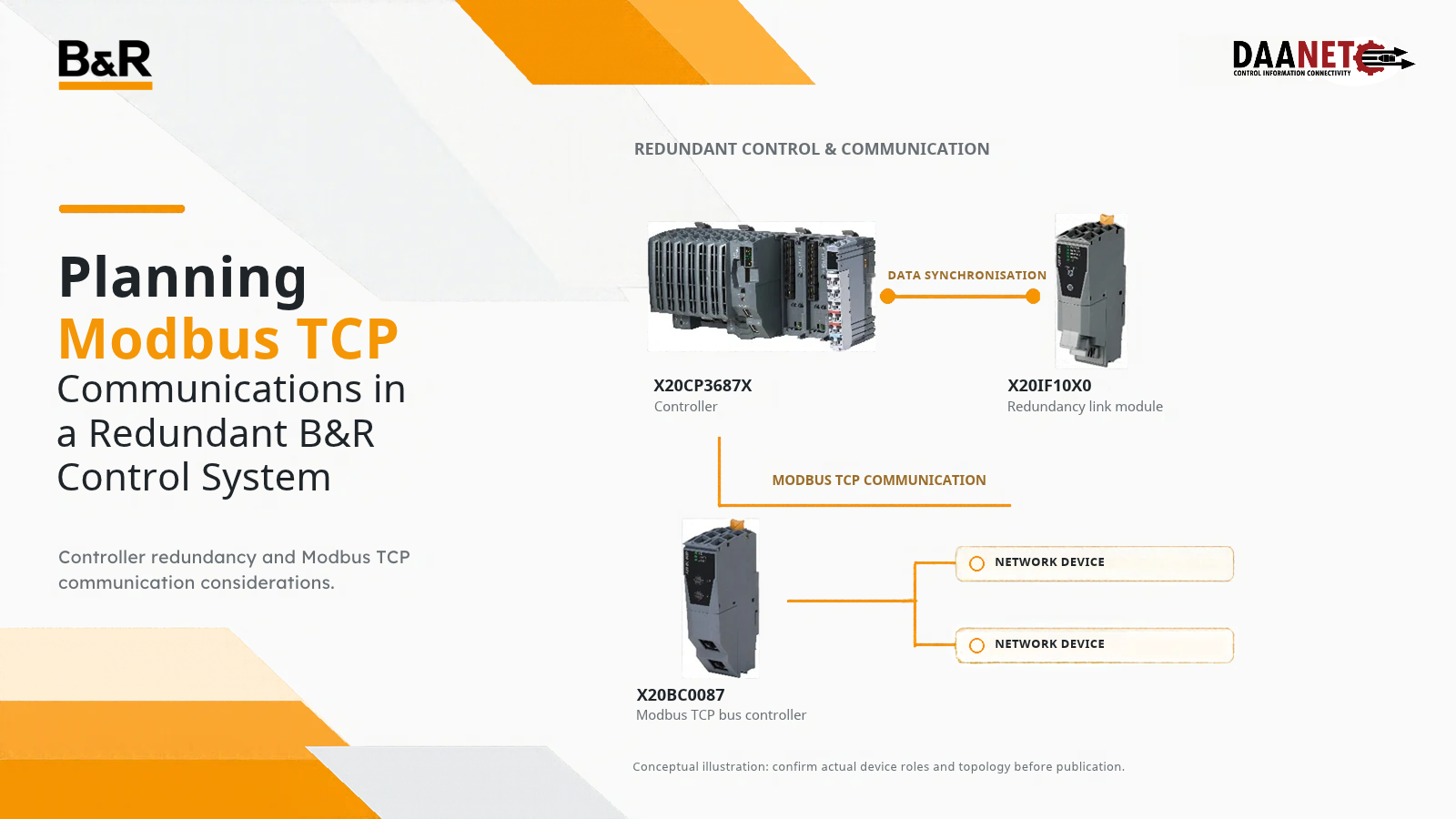
In building automation, control system availability depends on more than having a backup controller. The way connected devices communicate with the control system also needs to be considered—particularly when the system is designed to continue operating after a controller switchover.
B&R controller redundancy provides a primary and secondary controller that synchronise application data. If the active controller becomes unavailable, the secondary controller can take over. B&R’s Redundancy for Control Systems – Possibilities and Examples documentation describes this functionality, including synchronisation in the microsecond range and a maximum of two lost cycles during switchover under the documented configuration.
However, when Modbus TCP devices are part of the architecture, engineers must also consider how those communication connections behave when control transfers between controllers.
Controller Redundancy Is Only One Part of the Design
A redundant controller arrangement helps maintain control system availability, but external communication needs to be considered separately.
For systems using Modbus TCP, this includes understanding how the master establishes connections with slave devices, which network interface is used, and how communication is handled when the active controller changes.
These details matter because a controller switchover does not automatically guarantee that every external device or monitoring system will maintain its existing communication session.
Understanding the Modbus TCP Configuration
The Modbus TCP implementation selected for a B&R application can influence how communication behaves within a redundant architecture.
B&R Automation Studio provides integrated Modbus TCP functionality, while software libraries such as MBusTCP offer a separate implementation approach. These options should not be treated as interchangeable.
The selected method needs to be evaluated against the actual application requirements, including:
● The number of Modbus TCP slave devices.
● The number of simultaneous connections required.
● The volume of data exchanged and the required update rates.
● The network interfaces and IP addresses used for communication.
● The behaviour of connections following a controller switchover.
Selecting the appropriate implementation early helps ensure that the communication design is considered alongside the controller architecture, rather than treated as a separate integration task.
What Happens During a Controller Switchover?
One important consideration is how Modbus TCP communication is affected when the active controller changes.
The B&R Community has documented configuration-specific discussions about Modbus TCP source IP behaviour in redundant systems. In one reported CP3685 configuration, requests originated from the active controller's IP address rather than the cluster IP. A separate discussion describes an MBusTCP library implementation using the cluster IP, with the communication function requiring reactivation following a switchover.
These examples highlight why the selected implementation, controller configuration and expected recovery behaviour should be verified before deployment.
For an engineering team, the practical questions include:
● Does the selected Modbus TCP implementation use the controller's individual IP address or the cluster IP?
● What happens to existing connections when the active controller changes?
● Do slave devices or monitoring systems need to re-establish communication?
● Is any application-level action required to restore communication after switchover?
Answering these questions helps establish realistic expectations for communication recovery and supports a more reliable system design.
Planning for Communication Load
The number of connected devices is another important part of the design.
A system communicating with multiple Modbus TCP slave devices needs to account for more than the total device count. Data volume, polling frequency, response times and simultaneous connections all influence communication performance.
For this reason, the required data exchange should be assessed against the capabilities of the selected controller, software implementation and network architecture.
Where the application is expected to expand, considering future device connections and additional data requirements during the design stage can also help avoid unnecessary changes later.
Designing Beyond the Controller
A redundant control system should be considered as a complete architecture.
Controller redundancy, network design, communication behaviour and connected-device requirements all contribute to the overall availability of the application. B&R's redundancy documentation also distinguishes controller redundancy from network redundancy, showing that these address different potential points of failure.
For building automation applications, this means evaluating not only how the secondary controller takes over, but also how the wider communication system responds when that happens.
A reliable redundant architecture is not defined by the backup controller alone. It is defined by how the entire system is designed to respond when a component fails.
Planning the controller configuration, Modbus TCP implementation and communication recovery strategy together gives engineering teams a stronger foundation for dependable building automation systems.
Planning a redundant B&R control system? Contact DAANET to discuss your application requirements and explore the right control and communication architecture for your project.
