
Guard Monitoring vs. Guard Locking: How to Choose the Right Safety Function for Your Machine
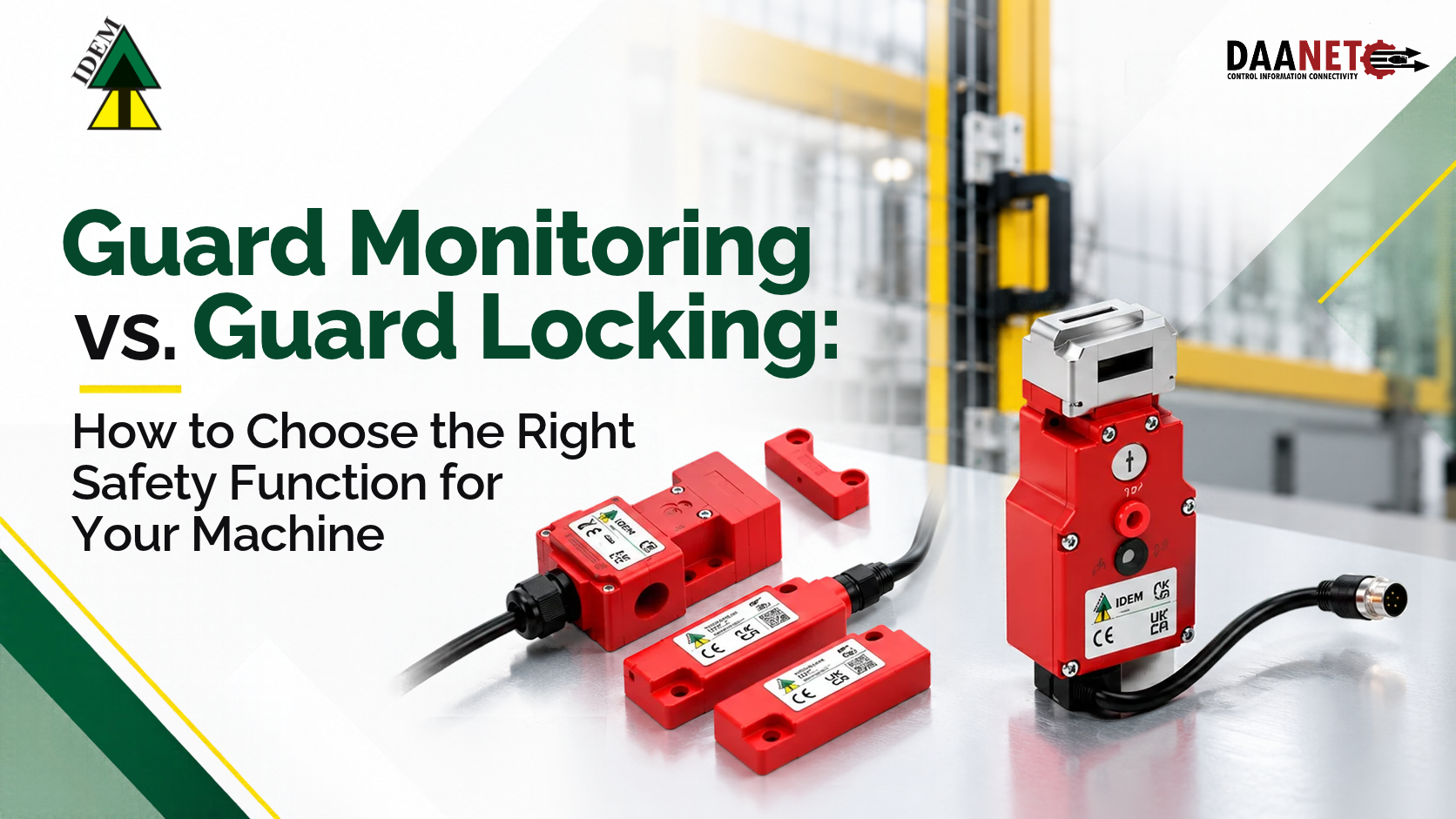
Understanding the difference between detecting an open guard and preventing access to hazardous machinery is essential to effective machine safety.
Machine guards help protect operators from moving parts and other hazards, but the guard itself is only one part of a complete safety system. The safety function used to monitor or secure that guard must be appropriate for the machine’s risks.
Two commonly used functions are guard monitoring and guard locking. Although they can work together, they serve distinct purposes.
What Is Guard Monitoring?
Guard monitoring detects the position of a machine guard, door, or access panel and communicates its status to the machine’s safety-related control system. When the guard opens or is incorrectly positioned, the system responds according to its safety design, typically preventing hazardous operation from starting or initiating a stop.
Non-contact safety interlock switches can perform this function without requiring physical contact between the sensing components. Depending on the application, technologies such as coded magnetic sensors and RFID-based switches can help monitor access points while reducing opportunities for tampering.
Typical applications include:
Machine access doors where opening the guard must initiate a safety response.
Enclosures and covers used to restrict access to hazardous areas.
Automated equipment where guard status must be monitored by a safety control system.
However, detecting that a guard has opened does not, by itself, physically prevent the guard from opening.
What Is Guard Locking?
Guard locking adds a mechanical locking function that holds a protective guard closed until the specified release conditions are met.
This is particularly important when opening a guard could expose someone to hazards that remain present after a stop command, such as machinery that requires time to coast to a stop or equipment with another residual hazard.
A guard-locking safety interlock can monitor both the guard’s position and its locked status. Depending on the design, the locking mechanism may be power-to-unlock or power-to-lock.
The release strategy must be selected according to the application’s risk assessment and safety requirements.
Typical applications include:
High-speed machinery that requires time to stop.
Automated production equipment with hazardous movement inside an enclosure.
Processes where opening an access door before hazardous conditions have ended could expose an operator to danger.
Guard locking does not replace the need for appropriate hazard assessment, stopping controls, or other protective measures.
The Key Difference: Detection vs. Restraint
The fundamental distinction is straightforward: guard monitoring detects the guard’s position, while guard locking physically restrains the guard from opening until release is permitted.
A guard-locking device may incorporate guard monitoring as well, so these functions are not necessarily mutually exclusive.
The appropriate choice depends on the hazards involved, the time required for hazardous conditions to cease, the possibility of access during that period, and the performance required of the complete safety-related control system.
How Do You Choose the Right Safety Function?
Before selecting a safety interlock, machine builders and safety professionals should consider:
1. Identify the hazards. Determine what risks are present inside the guarded area and what could happen if someone gains access.
2. Assess stopping time and residual hazards. Establish whether hazardous movement or other dangerous conditions may persist after a stop command.
3. Determine the required safety performance. The complete safety function must meet the performance requirements established by the machine’s risk assessment and applicable standards.
4. Select suitable interlocking technology. Consider the guard design, operating environment, resistance to tampering, diagnostic capabilities, and any required locking or escape-release features.
5. Validate the complete system. Correct device selection, installation, integration, and testing are essential. A safety interlock alone does not establish that the entire machine is safe.
Find the Right Machine Safety Solution with DAANET
Choosing between guard monitoring and guard locking is not simply a matter of selecting a switch. It means identifying the safety function required by the application and selecting equipment that supports that requirement. IDEM Safety offers a range of machine safety solutions, including non-contact safety interlock switches and guard-locking safety interlocks, designed for different machine guarding applications.
Need help identifying a suitable safety interlock for your application?
Contact DAANET to discuss your machine safety requirements and explore the available IDEM Safety solutions for your needs. The right solution starts with understanding the hazard.
Technical note: Final device selection and system design should be based on an application-specific risk assessment, the manufacturer's instructions, and applicable machinery-safety standards.
